The history of Alsace: World War II
France falls
France was attacked by Germany on May 10, 1940. France had simply chosen the wrong strategy, planning for a classic assault on the Maginon defence line ranging from Alsace to Lorraine. It is interesting to note that this strategy had earlier been severely criticized by a young infantry colonel, Charles de Gaulle, who argued that only rapid and dynamic mechanised armed forces could defend France.
De Gaulle was right, the French forces could not meet the Germans, suffered heavy losses and became disorganized only days after the hostilities began.
On June 17, France was defeated. Germany occupied the northern part, while the invaders allowed General Petain, a hero of World War 1 to manage southern part from Vichy.
Alsace becomes a part of the Third Reich
But for Alsace and Lorraine, things turned out even worse. Taking an eye for eye, the two regions that were returned to France in the Versaille peace treaty were annexed. From August 25 1942, all Alsatian men could be forced to join Wehrmacht, just as in Germany. In total 130 000 "former" Frenchmen were enrolled in the German army.
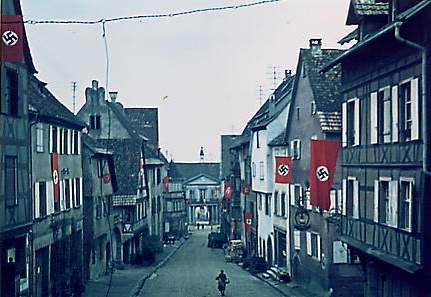
Riquewihr 1942. Courtesy of Etienne Hugel.
Most of the youngsters, commonly known as malgré-nous, "despite-us"" were sent to the eastern front to fight Stalin. Sadly, 40 000 Alsations were killed or reported missing, 30 000 were wounded and 10 000 were deported.
This immense humiliation added a lot of symbolic value to the liberation of Alsace. The man given the credit was General Leclerc. Today, there is not a town, village or hamlet without a Rue General Leclerc. The name was an alias, his real name was Philippe de Hautecloque. De Gaulle had great confidence in Leclerc who was one of the first to join the President-to-be in London. Leclerc stood bu de Gaulle in northern Africa while the General, against the will of Roosevelt, built up the Free French Army.
The battle of the Colmar pocket
The Allied reached the heart of Alsace the first days of December. The mission of the Americans was to clear the Colmar pocket, poche de Colmar, where the Germany had concentrated its remaining troops, mostly young but thoroughly trained SS-recruits. The Colmar pocket is the plain stretching from Kaysersberg to Colmar.
The battle of the Colmar pocket lasted for 2 terribly violent and cold months. Thousands were killed in battle, hundreds died from the cold and the medieval villages Mittlewihr, Bennwihr, Sigolsheim, Ammerschwihr and Katzenthal were destroyed.
The U.S. Army arrives
The Americans passed the Voges via a snow-covered Col de Bonhomme on December to the outskirts of Kaysersberg. The same day, the 141th Regiment 2 batallion passed St Marie-aux-Mines, liberated Ribeauvillé, Bergheim and Hunawihr and set up the command in Riquewihr late at night.
Sélestat was in Allied hands on December 7.
The allied were now just a few kilometres from the Germain defence line, stretching on the ridge that we now know as the northern borders of Grands Crus Mambourg, Furstentum and Schlossberg, then known as hills 351, 393 and 621.
The first attack on Sigolsheim was persued on December 8. That was to early. Even though the U.S. forces managed to get over the ridge and half way down the slope to Sigolsheim, tanks got stuck in wires of the vines and the losses were a catastrophy. An entire company, caught in the vineyards decided to continue into Sigolsheim and disappeared.
The days that followed, the U.S. troops were dug down around Grand Cru Mambourg, Furstentum and Sporen under heavy shelling and infantry assaults.
The counter attack
On December 12, some 600 young SS sneaked through Bois de Kientzheim from Kaysersberg to Riquewihr. Although it was a complete surprise, the attack was stopped by supply chain soldiers, cooks and others left in the village.

Used with permission from Texas Military Forces Museum.
The break-through
Hell prevailed until French tanks came to rescue on December 17. The attack on Kientzheim came trough the valley between Schlossberg and Furstentum. Fortunately, the final battle lasted for only an hour and Kientzheim was not badly damaged, despite 600 round of shells the night that followed.
The next morning, 4 French tanks made way to Kaysersberg where Gestapo and SS-soldiers were captured. The same night, Allied troops marched into the still burning remains of Ammerschwihr.
Although the distance between Kientzheim and Sigolsheim is a mere 800 meters, the Americans needed 10 days to reach and liberate Sigolsheim. When the population left the vine cellars where they had taken cover, often accompanied by desperate German soldiers, they found their village totally destroyed.
The last German soldier fled Sigolsheim wading in the ice-cold water of the Weiss river, carrying two comrades on his back.
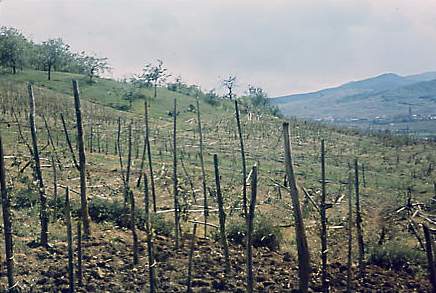
Spring of 1945. Damaged vines.
The liberation of Alsace
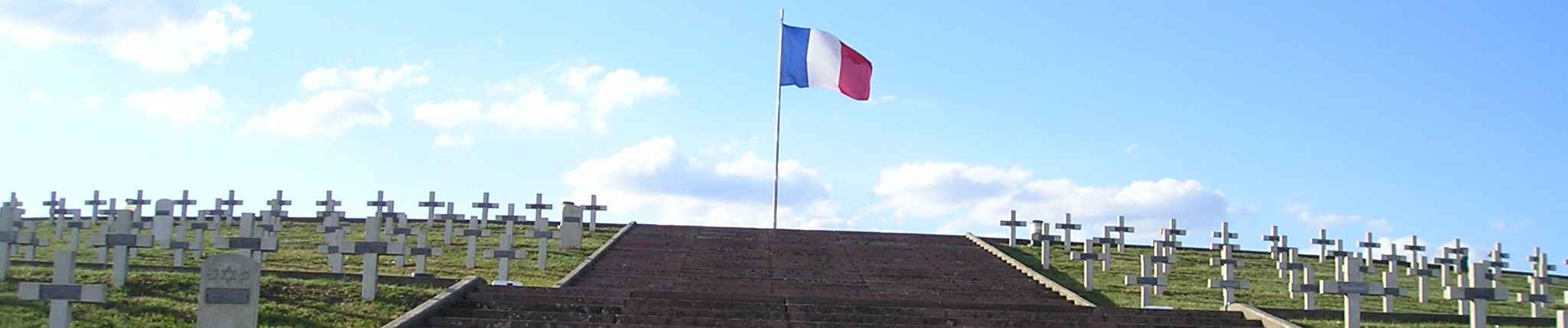
Colmar was liberated no earlier than February 2 1945. On February 5, the German troops were surrounded and on February 9 the entire Haut-Rhin was in the hands of the Allied. Many of the French casualties rest at the cemetery at Sigolsheim, shown on top.
The German cemetery, Soldatfriedenhof, is on Grasberg just outside of Bergheim.
Appoximately 1/3 of the French soldiers that died in Alsace were Muslims that had joined with General Leclerc already in northern Africa.
General Leclerc had fulfilled his promise to liberate Strasbourg on November 23 1944. But it took until March 20 1945 until Rhine was crossed at Wissembourg in northern Bas-Rhin. Alsace was free!
The aftermath
In Sigolsheim, the U.S. army is seen as brave liberators. In Ammerschwihr, however, I have picked up a genuine bitterness since no real attempt was made to actually liberate the village. As it turned out, it was flattened by artillery and air strikes.
During the liberation, some 25% of the troops were French but most of the troops were in fact American. The American losses in the Colmar pocket were well known in America. This contributed to the fact that the American public, according to a poll made in August 1945, held the Germans as more capable than the French population.
Sources
Web-site about the 36rd infantery division
Ståhlberg, Knut (2004) Charles de Gaulle, Nordstedts förlag, Stockholm
Personal communications with inhabitants of Sigolsheim and Ammerswihr
Thomson, A. A. (1996) Dissertation from University of Kent at Canterbury, England